

Home > HSS Cutting Tools > Counter Sink
HSS Cutting Tools Products
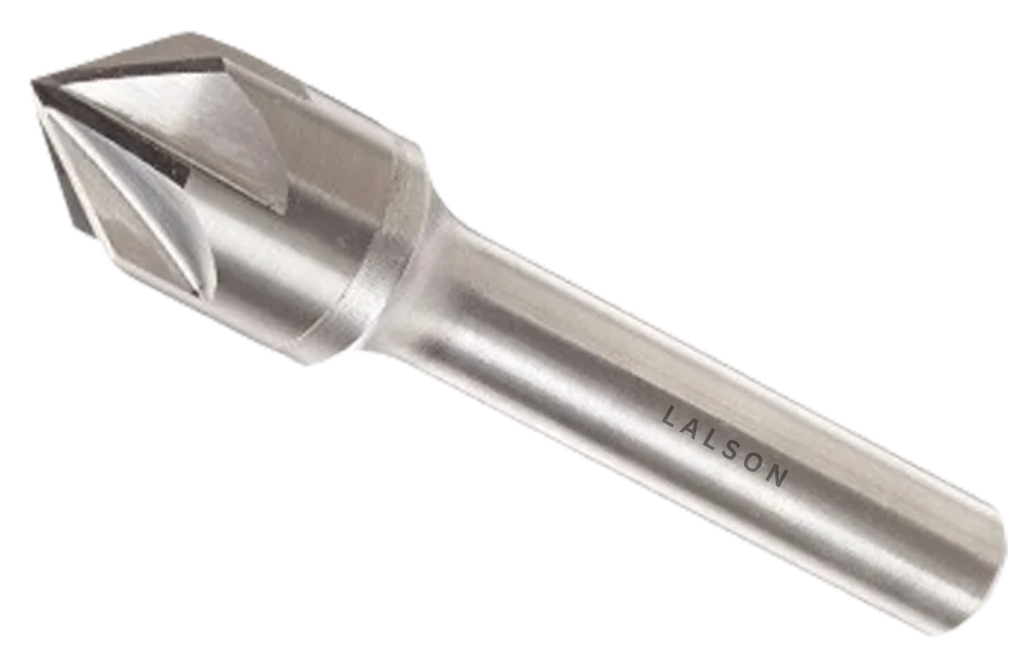
Counter Sink – Lalson Cutting Tools
Precision Cutting Solutions by LALSON
A countersink is a conical recess (or the tool that cuts it) machined at the top of a drilled hole so that a screw/fastener head sits flush with, or below, the surface. Here’s the full breakdown:
Purpose
- Lets flat-head or oval-head screws sit flush or recessed
- Removes burrs left after drilling
- Improves appearance and reduces snagging (safety, aerodynamics, aesthetics)
- Provides a locating/centering point for subsequent drilling operations
Product Details
Types of Countersink Tools
- Single-flute countersink — simplest, one cutting edge, economical, common for hand/manual use
- Multi-flute (3 or 5 flute) — smoother finish, less chatter, common for machine work
- Zero-flute countersink — no flutes, uses friction/burnishing edge; deburring, very chatter-free, common in aerospace
- Combination drill and countersink (center drill) — drills a pilot hole and countersinks in one operation (used for lathe centers, different from fastener countersinking)
- Cross-hole (bore-type) countersink — has a hole through the body for lubricant/chip clearance, and can be resharpened easily
- Interchangeable pilot countersink — has a guide pilot that follows an existing hole to keep the countersink concentric
Practical tips
- Always countersink after drilling the pilot hole, not before (unless using a combined drill/countersink tool)
- Run at slower speed than drilling — countersinks can grab and chatter if fed too fast
- For wood, a countersink bit is often combined with a tapered drill bit (“counter-drill” or “pilot-point combo bit”) to drill, taper, and countersink in one pass
- For sheet metal / aerospace, depth is checked with a countersink micrometer gauge to ensure the fastener sits within tolerance (flush ± a few thousandths of an inch)
Product Specification
| Angle | Common Use |
|---|---|
| 82° | Standard in US/imperial screws (flat head machine screws, wood screws) |
| 90° | Most common metric standard; also used for deburring |
| 100° | Aerospace/aircraft flush rivets |
| 120° | Deburring, some rivet types |
| 60° | Countersinking for centering (lathe centers — different application) |
Important: Using the wrong angle means the screw head won't seat flush — it'll either stick proud (angle too shallow) or the head will bottom out before the recess fills (angle too steep), and won't grip properly.
Why Choose LALSON CounterSink?
Precision Ground Cutting Edges for accurate and clean countersinking
Premium HSS Construction for exceptional durability and wear resistance
Smooth & Chatter-Free Performance for superior surface finish
Long Tool Life with excellent heat and abrasion resistance
Suitable for Multiple Materials including steel, stainless steel, cast iron, aluminum, and non-ferrous metals
Available in Various Angles & Sizes to meet diverse industrial applications
Strict Quality Control ensuring consistent performance and dimensional accuracy
Trusted by Industries Worldwide for reliable and cost-effective machining solutions
Product FAQ’s
1. What are LALSON Countersinks used for?
LALSON Countersinks are used to create chamfered holes for countersunk screws and rivets, remove burrs, and improve the finish of drilled holes. They are widely used in metalworking, woodworking, and precision machining applications.
2. What materials can LALSON Countersinks machine?
Our countersinks are suitable for machining a variety of materials, including steel, stainless steel, cast iron, aluminum, brass, copper, and other non-ferrous metals, depending on the tool grade and application.
3. What materials are LALSON Countersinks made from?
LALSON Countersinks are manufactured from premium High-Speed Steel (HSS) to provide excellent hardness, wear resistance, heat resistance, and long service life. Other material options may be available for specific industrial requirements.
4. Are LALSON Countersinks available in different sizes and angles?
Yes. We offer countersinks in a wide range of diameters, shank sizes, flute configurations, and standard countersink angles (such as 60°, 82°, 90°, 100°, and 120°) to suit different machining applications. Custom specifications are also available.
5. Why choose LALSON Countersinks?
LALSON Countersinks are trusted for their precision-ground cutting edges, smooth and chatter-free cutting, excellent surface finish, long tool life, and consistent quality. With decades of manufacturing expertise and global exports, we provide reliable tooling solutions for industries worldwide.
